Video Analytics: How Does It Work And Why Is It Important For Modern Security?
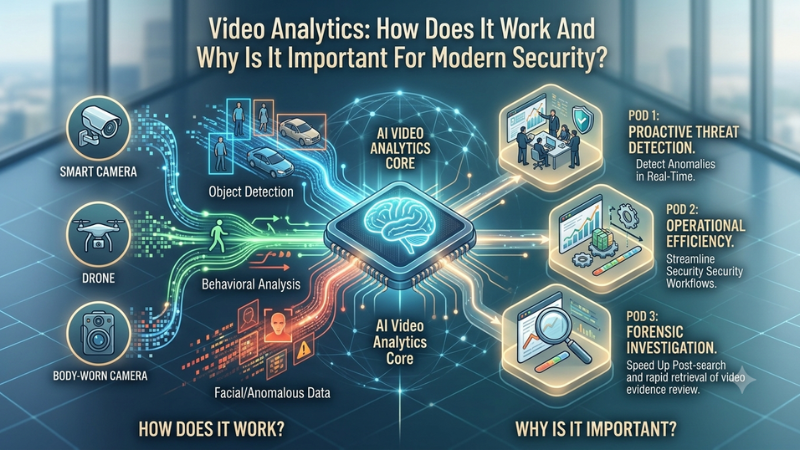
How can businesses monitor multiple security cameras, identify suspicious activities, and respond to potential threats without constantly watching every screen? Video Analytics provides an intelligent solution by automatically examining camera footage, detecting predefined activities, and generating alerts when specific events occur.Traditional surveillance systems primarily record footage for later investigation. Intelligent video monitoring goes further by analyzing visual information in real time, helping security teams identify unusual movements, unauthorized access, and other important events.As organizations increasingly depend on surveillance technology, automated video analysis is becoming a valuable tool for improving security, reducing manual monitoring, and supporting operational decisions.
What Is Video Analytics and How Does It Work?
Video Analytics is a technology that uses artificial intelligence, computer vision, and advanced algorithms to examine video footage and identify objects, movements, patterns, or specific events.Instead of requiring security personnel to review every recording manually, the technology processes visual information and highlights activities that match predefined detection rules.
How Does Technology Analyze Camera Footage?
The process begins when surveillance cameras capture video from monitored locations. The footage is then processed through software that identifies relevant visual information.Video Capture and ProcessingVideo Analytics systems capture footage through security cameras installed in monitored areas. The software processes these video streams, analyzes individual frames, and identifies relevant visual information to support accurate monitoring and event detection. Object Detection and ClassificationComputer vision algorithms identify objects such as people, vehicles, and other recognizable elements. Depending on the system, the software may distinguish between different object categories.Activity and Movement AnalysisThe technology examines movement patterns and object behavior to identify events such as restricted-area entry, prolonged presence, or unexpected movement.Automated Alerts and NotificationsWhen detected activity matches configured conditions, the system can generate notifications through monitoring dashboards, mobile applications, or other connected platforms.This automated workflow allows security teams to concentrate on relevant incidents rather than continuously reviewing routine footage.
What Are the Key Features of Intelligent Video Monitoring?
Modern intelligent surveillance platforms offer several capabilities that improve monitoring efficiency and provide useful information about activities within monitored environments.
Real-Time Event Detection
Real-time detection helps identify predefined activities as they occur. Security personnel can receive timely notifications when someone enters a restricted area or when unusual movement is detected.
Object Recognition and Tracking
Object recognition enables systems to distinguish between people, vehicles, and other objects. Tracking capabilities help monitor their movement across a camera's field of view.
Intrusion and Perimeter Monitoring
Cashier Absence Detection technology uses intelligent video monitoring to identify when a cashier is missing from a designated checkout counter. This capability helps retail stores, supermarkets, and shopping centers monitor cashier availability, reduce unattended checkout periods, and improve operational efficiency.
Crowd and Occupancy Analysis
Some platforms estimate occupancy levels, detect crowd formation, and analyze movement patterns. These insights can support space management and operational planning.
Intelligent Video Search
Advanced search capabilities help investigators locate relevant footage using criteria such as object type, location, or event time. This reduces the effort required to examine lengthy recordings.
How Can Automated Video Analysis Improve Security?
Automated surveillance analysis helps organizations identify important activities more efficiently while reducing dependence on continuous manual observation.
Faster Incident Identification When suspicious activities match configured detection rules, automated alerts can notify security teams promptly. Faster identification may support quicker investigation and response.
Reduced Manual Monitoring Security personnel often manage footage from numerous cameras simultaneously. Automated detection highlights relevant events, allowing operators to focus on situations requiring attention.
Improved Investigation Efficiency Searchable footage and event-based recordings help investigators locate important information without reviewing hours of unrelated video.
Better Operational Awareness Beyond security applications, movement and occupancy information can help organizations understand how monitored spaces are used.However, automated detection does not guarantee accurate identification in every situation. Effective performance depends on camera placement, environmental conditions, software configuration, and human verification.
Where Is Intelligent Video Surveillance Commonly Used?
Intelligent video monitoring supports security and operational activities across several industries.
Retail Stores and Shopping Centers
Retail businesses can use automated monitoring to detect restricted-area entry, observe customer movement patterns, and support loss-prevention activities. Occupancy information may also help improve store operations.
Warehouses and Manufacturing Facilities
Industrial environments benefit from monitoring sensitive areas, detecting unauthorized movement, and identifying selected safety-related events.
Commercial Buildings and Offices
Office facilities can use intelligent surveillance to monitor entrances, parking areas, and restricted sections. Integration with other security technologies may improve overall situational awareness.
Transportation and Parking Facilities
Transportation environments can use vehicle detection, traffic movement analysis, and occupancy monitoring to support security and operational management.
What Is the Future of AI-Powered Video Monitoring?
Advancements in artificial intelligence are making intelligent surveillance systems more capable of recognizing complex activities and analyzing visual information.Future developments may improve event classification, reduce unnecessary alerts, and strengthen integration with building management and security platforms.Edge computing may also enable more processing directly on compatible cameras or nearby devices, reducing dependence on centralized infrastructure.As these capabilities develop, responsible implementation, accuracy testing, and privacy protection will remain essential.
You can also watch: AI-Powered Line Cross Detection: Secure Your Restricted Zones
Conclusion
Intelligent video monitoring transforms traditional surveillance into a more proactive security solution by detecting activities, generating alerts, and simplifying footage investigations.For businesses operating warehouses, factories, commercial buildings, and other high-risk facilities, AI Fire Detection can improve early identification of visible smoke and flames, enhance monitoring efficiency, and support faster emergency responses. However, reliable performance depends on proper camera placement, suitable infrastructure, accurate system configuration, regular testing, and human oversight.
Frequently Asked Questions
Can Intelligent Video Monitoring Work With Existing CCTV Cameras?
Yes. Some platforms support existing IP cameras and compatible surveillance infrastructure. However, integration depends on camera specifications, network capabilities, and software requirements.
Does Automated Video Analysis Require Artificial Intelligence?
Not always. Traditional systems may use motion detection and predefined rules, while advanced platforms use AI and computer vision for more sophisticated recognition and analysis.
Can Intelligent Surveillance Completely Replace Security Personnel?
No. Automated monitoring helps identify relevant events, but human supervision remains important for verifying alerts, investigating incidents, and making security decisions.